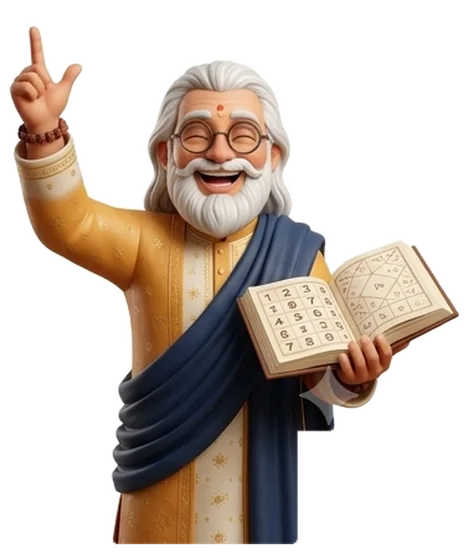
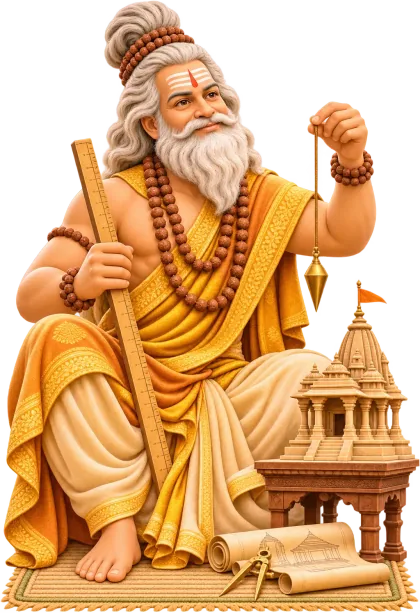
Who is Vishwakarma?
The name means “maker of all”. In the Rigveda it is a name of the creator himself. The Mahabharata gives him a family: he is born to Prabhasa, the eighth of the Vasus, and the sister of Brihaspati, and he is “the lord of crafts, the maker of a thousand crafts, the carpenter of the gods” (Adi Parva 1.60.26–27).
Some texts speak of the gods’ craftsman as Tvashtri instead, and the two are often taken as one.
Why does tradition honour him?
Every craft that shapes matter, the mason’s, the carpenter’s, the smith’s and the sculptor’s, looks to Vishwakarma as its patron.
On Vishwakarma Puja, held on Kanya Sankranti, the day the Sun enters Kanya (usually around 17 September), workers in workshops and factories clean their tools and machines and worship them. It is kept most widely in eastern India; in some places the day falls after Diwali instead.
Vishwakarma in the Vedas
Rigveda 10.81 and 10.82 are addressed to Vishvakarman as the maker of the worlds. He has eyes on every side, a face on every side, arms and feet on every side (10.81.3), and the poet asks what wood it was, what tree, from which heaven and earth were carved (10.81.4). He is the one who gives the gods their names (10.82.3).
Vishwakarma in the epics and Puranas
The Mahabharata calls him the maker of all ornaments, foremost among craftsmen, who built the gods’ flying palaces, the vimanas (Adi Parva 1.60.28).
In the Ramayana he tells the rakshasa brothers Malyavan, Sumali and Mali that he built the city of Lanka at Indra’s command, on Mount Trikuta by the southern sea (Uttara Kanda 5); later, Sita is shown “Lanka, built by Vishwakarma” (Yuddha Kanda 111.3).
For Krishna he builds Dwaraka in the sea: the Harivamsha names him outright (Vishnu Parva), and the Bhagavata Purana describes the city as showing Tvashtri’s skill in every craft (10.50.49–50).
What did Vishwakarma give the shastras?
Vastu traces its knowledge to him. The Matsya Purana’s list of eighteen teachers of Vastu names Vishwakarma fourth, after Bhrigu, Atri and Vasishtha, and beside Maya, the architect of the asuras (chapter 252).
Works on building circulate under his name, among them the Vishwakarma Prakasha, a treatise on house building in the North Indian tradition. Its date cannot be fixed: the known manuscripts are late copies (one is dated 1803), and the scholar D. N. Shukla found no reliable date for the works in his name.
Vishwakarma on RishiSetu
Vishwakarma is the guide of the Vastu Shastra course. It begins with the Vastu Purusha Mandala, the eight directions, the five elements and the plot, goes through the house room by room, its doors and its measurements, and ends with full site audits.
Lessons name their texts: the Mayamata, the Manasara, the Vishwakarma Prakasha, the Samarangana Sutradhara and chapter 53 of the Brihat Samhita. Where a rule comes from later teachers rather than the texts, the course says so.
Sources
- Rigveda, 10.81 and 10.82
- Mahabharata, Adi Parva, 1.60.26–28 (Ganguli’s section 66)
- Valmiki Ramayana, Uttara Kanda 5; Yuddha Kanda 111.3
- Harivamsha, Vishnu Parva, the building of Dwaraka (M. N. Dutt’s chapter 99)
- Bhagavata Purana, 10.50.49–50
- Matsya Purana, chapter 252, the eighteen teachers of Vastu
- D. N. Shukla, Vastu-Sastra, 1960, on the works attributed to Vishwakarma