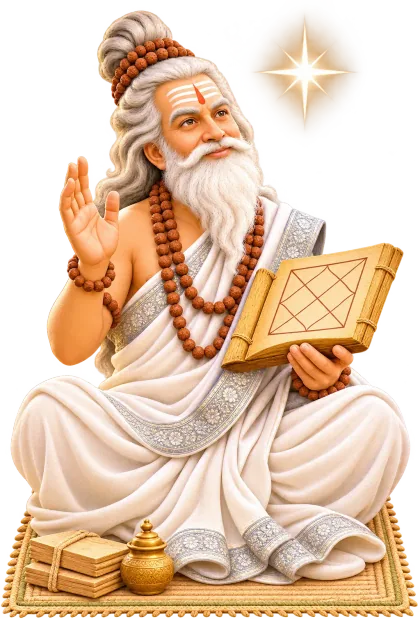
Who was Bhrigu?
The Puranas count Bhrigu among the sons Brahma brought forth to people the world: the Bhagavata Purana lists him among ten (3.12.22), and the Manusmriti names him among the ten Prajapatis (1.35). The texts tell his birth differently. In the Bhagavata he comes from Brahma’s skin (3.12.23); in the Mahabharata he comes out of Brahma’s heart (Adi Parva 1.60.40).
His wife Puloma bore him Chyavana. Through Chyavana runs the Bhargava line, which the Mahabharata follows down to Jamadagni and his son Parashurama, known as Bhargava Rama. Shukra, the teacher of the asuras, belongs to the same line: Bhrigu’s son in some accounts, and the son of Bhrigu’s son Kavi in others (Mahabharata 1.60.40; Bhagavata Purana 4.1.45).
Why does tradition honour him?
In the Bhagavad Gita, Krishna names what is greatest in each kind of thing, and says: “Among the great seers, I am Bhrigu” (maharṣīṇāṃ bhṛgur aham, 10.25).
The Manusmriti presents its whole teaching as recited by Bhrigu: Manu says that Bhrigu learned it from him and will tell it to the sages in full, and Bhrigu begins (1.59–60). A seer trusted to hand on a whole shastra is the picture of Bhrigu the tradition keeps.
Bhrigu in the Vedas
The Rigveda speaks of the Bhrigus, his family of priests, in hymns to Agni. They “established” fire among people (1.58.6), and searching, they found Agni where he lay hidden (10.46.2). Another hymn says Matarishvan brought fire to Bhrigu (1.60.1).
The third part of the Taittiriya Upanishad, the Bhriguvalli, is named after him. Here he is Bhrigu Varuni, Varuna’s son. He goes to his father and asks to be taught Brahman. Varuna tells him it is that from which beings are born, by which they live and into which they return. Bhrigu seeks it through tapas, and finds it step by step: as food, as breath, as mind, as understanding and, at last, as bliss (3.1–6). The Upanishad calls this “the knowledge of Bhrigu and Varuna”.
Bhrigu in the Puranas and epics
The Mahabharata’s Pauloma section tells how a rakshasa carried off Puloma, and how her unborn son fell from her womb in the struggle and was named Chyavana, “the fallen one”. Agni had told the rakshasa whose wife she was, and Bhrigu cursed Agni for it (Adi Parva, Ganguli sections 5–6).
The Bhagavata Purana tells of a test. Sages gathered on the Sarasvati could not agree which of the three great gods was highest, and sent Bhrigu to find out. He showed Brahma and Shiva no respect; at Vaikuntha he struck the resting Vishnu on the chest with his foot. Vishnu rose, bowed to him and asked his pardon, and the sages concluded that Vishnu was the greatest (10.89.1–17). The story is remembered for Vishnu’s humility.
What did Bhrigu give the shastras?
Jyotish: traditional lists of the eighteen founders (pravartakas) of Jyotisha include Bhrigu. The Narada Samhita gives one such list (1.2–3); other versions of the list differ in some names, so no single list is the list.
The Bhrigu Samhita, a collection of ready-made horoscope readings, is traditionally attributed to him. No complete manuscript is known, there is no critical edition, and its date and authorship are not established; the loose pages consulted in places such as Hoshiarpur and Varanasi have not been studied as a whole. The Bhrigu Sutras, short results for each graha in each house, also carry his name.
Vastu: the Matsya Purana lists eighteen teachers of Vastu, and Bhrigu is the first name in the list (chapter 252).
Bhrigu on RishiSetu
Bhrigu is the guide of the Vedic astrology course. It starts from zero, with the twelve rashis, the nine grahas, the twenty-seven nakshatras and the twelve houses, and goes on to reading a whole chart and timing events with dashas. An advanced lesson covers the Bhrigu Sutras, and an elective covers Nadi astrology.
Each rule names its classical source, most often Brihat Parashara Hora Shastra, and the course teaches what the texts say, never a promise about what will happen.
Sources
- Bhagavad Gita, 10.25
- Taittiriya Upanishad, Bhriguvalli (book 3), anuvakas 1–6
- Rigveda, 1.58.6, 1.60.1 and 10.46.2
- Manusmriti, 1.35 and 1.59–60
- Mahabharata, Adi Parva, the Pauloma section (Ganguli’s sections 5–6) and 1.60.40 (Ganguli’s section 66)
- Bhagavata Purana, 3.12.22–23, 4.1.43–45 and 10.89.1–17
- Narada Samhita, 1.2–3, the eighteen founders of Jyotisha
- Matsya Purana, chapter 252, the eighteen teachers of Vastu
- Encyclopedia of Occultism and Parapsychology, “Bhrigu Samhita”, on its attribution and manuscripts