Learn Vedic astrology online, from your first chart to a full reading
RishiSetu’s Vedic astrology programme is four courses, Basic, Intermediate, Advanced and Professional, 38 levels in all. It starts with the 12 rashis and 9 grahas and goes on to full readings, first in the Parashari tradition and then in the other major systems. Each course ends with an exam that opens the next. Lessons take a few minutes, use a live North Indian chart, and are in Hindi, English and other Indian languages. You start with Basic Astrology.
- 4 courses · 38 levels
- 10 languages
- Parashari method
- Lahiri ayanamsha
What are the four Vedic astrology courses?
Basic, Intermediate, Advanced and Professional. Each course has its own certificate, and the courses open in order.
- 1Basic
Jyotish Shishyaज्योतिष शिष्य
7 levels
From the sky as a map to reading your own chart layout.
- 2Intermediate
Jyotish Sadhakaज्योतिष साधक
7 levels
Calculate a chart by hand, read its houses and lords, and learn dasha and transits.
- 3Advanced
Jyotish Vidvanज्योतिष विद्वान
19 levels, in two parts
Parashari in depth, then the other major systems.
- 4Professional
Daivajnaदैवज्ञ
5 levels
Ethics, full readings, case studies and practice consultations with an AI client.
Every level ends with a mastery check and every course ends with an exam. Passing the exam earns the course’s certificate and opens the next course. After Advanced, electives in Lal Kitab and Nadi astrology in depth.
Where does the course begin?
Basic Astrology · Jyotish Shishya · 7 levels
A few of the first topics:
- The 12 rashis and their lords
- The 9 grahas, Rahu and Ketu included
- Where a graha is strong or weak
- The 12 houses of the chart
How do you practise reading charts?
Reading a chart is a skill, so most of the course is doing, not watching.
- Tap houses and grahas on the chart, place grahas in their signs, and count signs from the Lagna.
- Practise on new charts calculated for random dates, times and places, so you cannot learn answers by heart.
- Mastery checks use charts you have never seen; you pass at 85%.
- Ideas you miss come back in a short daily review until they stick.
- Every answer, right or wrong, shows the reason and the classical rule behind it.
Which tradition does RishiSetu teach?
RishiSetu teaches the Parashari tradition, with the sidereal zodiac and the Lahiri (Chitrapaksha) ayanamsha, and whole-sign houses counted from the Lagna. Each rule names its source, mainly Brihat Parashara Hora Shastra, with Brihat Jataka and Phaladeepika for transits and yogas. Where traditions disagree, for example on which signs Rahu and Ketu rule, the lesson says so instead of picking one silently.
Try a lesson from the Basic course
Each lesson has a short preview here; the full lesson, with its diagrams and practice, opens in the app.
- Counting from a sign
- Debilitation (neecha)
- Divisional charts: D9 and D10
- Exaltation (uchcha)
- Five ages in a sign (Baladi)
- Friends, enemies and neutrals
- Gender, guna, element and dhatu
- Groups of houses
- Houses 1 to 3: self, wealth, courage
- Houses 10 to 12: work, gains, letting go
- Houses 4 to 6: home, children, struggle
- Houses 7 to 9: partner, the hidden, fortune
- How close: degrees between grahas
- How strong is a graha in its sign?
- Jupiter (Guru)
- Jupiter's nakshatras
- Kalapurusha, the body of time
- Ketu
- Ketu's nakshatras
- Lagna chart and Moon chart
- Lunar months, Sankranti and eclipses
- Mars (Mangal)
- Mars's nakshatras
- Mercury (Budha)
- Mercury's nakshatras
- Movable, fixed and dual
- North, South and East Indian charts
- Odd and even, day and night, rising and direction
- Own sign and moolatrikona
- Padas: quarters of a nakshatra
- Place the grahas
- Rahu
- Rahu's nakshatras
- Read the North Indian chart
- Reading a graha's degree
- Saturn (Shani)
- Saturn's nakshatras
- The 12 rashis in order
- The birth chart (D1)
- The edges of a sign: sandhi and gandanta
- The four elements
- The highest degree: Atmakaraka
- The lords of the signs
- The Moon (Chandra)
- The Moon's nakshatras
- The nine grahas
- The nine nakshatra lords
- The Panchang in brief
- The parts of Jyotish
- The sky is a map
- The Sun (Surya)
- The Sun's nakshatras
- The twelve bhavas
- Vargottama: the same sign twice
- Venus (Shukra)
- Venus's nakshatras
- What a house is
- What a nakshatra is
Who is this subject traced to?
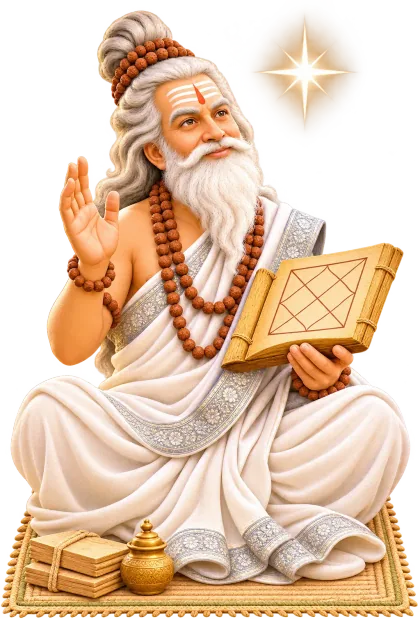
Bhrigu Rishi
A great seer of the Vedic tradition, named in the Gita, and counted among the founders of Jyotish.
Guruji, your guide
Questions people ask before they start
Inside the app, you can ask Guruji about any lesson, in your own language.
Are all four astrology courses ready?
Yes. All four courses, Basic to Professional, are written, with a mastery check for every level and an exam for every course. You start with Basic Astrology, and each course opens when you pass the exam of the one before it. Experienced astrologers can take a course’s exam to skip ahead.
How long does the Vedic astrology course take?
It depends on your pace. Lessons take 5 to 8 minutes, so 15 minutes a day is a lesson or two plus review. The basics take weeks; reading charts with confidence takes months of practice, and each later course builds on the one before it.
Do I need to know Sanskrit or Hindi?
No. Every Sanskrit term (rashi, graha, bhava, nakshatra) is introduced with its meaning, and you can learn in English. If you prefer Hindi, the whole course is in Hindi too.
Do I need my birth time to learn?
No. Lessons and practice use sample charts. If you want to see each idea in your own chart, you can enter your birth date, time and place, which stay on your device.
Does the course use the North Indian or South Indian chart?
Lessons draw the North Indian chart. The Basic course also explains the South Indian and East Indian layouts, so you can read charts in any of them.
Your first lesson takes about five minutes
Sign in with your email, choose your language, and start at the beginning. RishiSetu keeps your place.