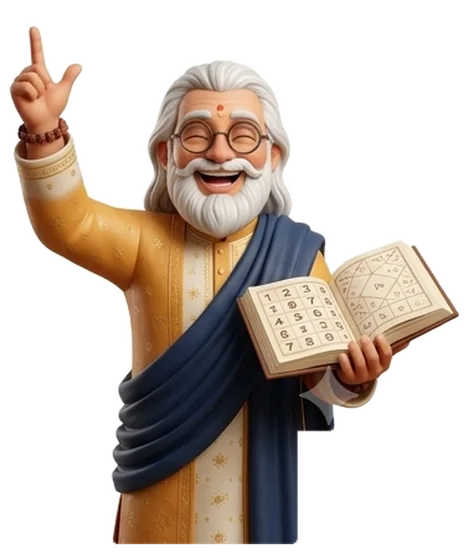
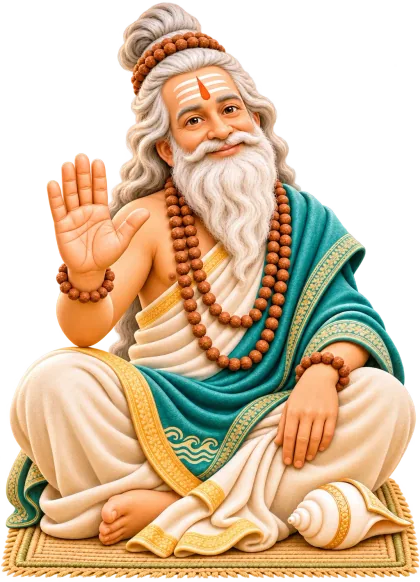
Who was Samudra?
Tradition names a sage Samudra as the teacher Samudrika is named after, and later manuscripts on body marks are credited to him, as others are credited to Narada or Garga. No early text gives his family, his teacher or his life, so this page does not invent one.
The word sāmudrika is formed from samudra, the ocean, and some accounts make the teacher the Ocean itself. A summary of the Bhavishya Purana tells how a treatise on the marks was thrown into the sea, and Samudra completed it; the shastra is named after him for that reason.
Why does tradition honour him?
Because the shastra carries his name. Indian learning often names a body of knowledge after the seer it is traced to, and Samudrika is remembered as Samudra’s teaching even though its surviving verses were written by later authors.
The subject itself is honoured in the Puranas: in the Shiva Purana, Shiva teaches Sati the sāmudrika-śāstra (Rudra Samhita, Sati Khanda, chapter 23, in J. L. Shastri’s translation).
Samudra in the Vedas
The Vedas have no hymn to a sage named Samudra. In the Rigveda, samudra is the ocean, or the gathered waters. A shastra of body marks, set out feature by feature, appears in later texts.
Samudrika in the Puranas and epics
The Garuda Purana gives chapters to the marks of men and of women (Purva Khanda, chapters 63–65; some editions put the last two the other way round). They list features from the feet to the head, and the result the text gives for each.
The same Purana and the Brihat Samhita also advise choosing a bride by her marks. RishiSetu teaches these verses as history, to show what the texts say and the ideals of their time; it never uses them to choose or reject anyone.
The texts of Samudrika
Brihat Samhita, by Varahamihira (6th century CE): a chapter on the marks of men (68), one on the five great men, Hamsa, Shasha, Ruchaka, Bhadra and Malavya (69), and one on the marks of women (70), in Bhat’s numbering; some editions count one lower.
Samudrika Tilaka: a verse treatise by Durlabharaja, a minister under the Chaulukya king Kumarapala in Gujarat, begun around 1160 CE and, by Kenneth Zysk’s account, finished by his son around 1175. Zysk’s The Indian System of Human Marks (2016) is the scholarly survey of these texts.
Every one of these texts names a feature and then its phala, the result it gives. They describe what the tradition said; they are not a verdict on a person’s character, health or future.
Samudra on RishiSetu
Samudra is the guide of two courses. Hasta Samudrika, the reading of the hand, covers hand types, mounts, the main and minor lines, timing on the hand and full readings of both hands. Samudrika Shastra reads the whole body: build and proportion, the face, the voice, the gait and marks such as moles.
Both teach each statement with its text, and both keep one rule: what the texts say, never a judgement of anyone’s worth, health or character.
Sources
- Varahamihira, Brihat Samhita, chapters 68–70 (Bhat’s numbering)
- Garuda Purana, Purva (Achara) Khanda, chapters 63–65 (M. N. Dutt’s translation, 1908)
- Durlabharaja, Samudrika Tilaka, about 1160 CE
- Kenneth G. Zysk, The Indian System of Human Marks, Brill, 2016
- Shiva Purana, Rudra Samhita, Sati Khanda, chapter 23 (J. L. Shastri’s translation)
- Bhavishya Purana, as summarised in “Essence of Bhavishya Purana”, on the naming of Samudrika
- Monier-Williams, Sanskrit–English Dictionary, sāmudrika, from samudra